.png?width=200&height=41&name=Logo%20Humakina%20new%202025%20(1).png)
.png?width=200&height=41&name=Logo%20Humakina%20white%20new%202025%20(1).png)
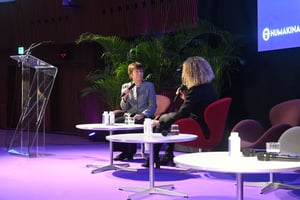
Some conversations stay with you long after the room has emptied. The dialogue between Naouelle Tir and Donatella De Vita was one of those moments.
On stage at the HR Evolution Summit in Luxembourg, there was no distance, no jargon, no rehearsed answers. Naouelle Tir, Managing Director of Prolingua, brought the reality she encounters every day, the subtle tensions, the unspoken barriers, the small frictions that shape people’s experience at work.
Facing her, Donatella De Vita, Global Head of Welfare, Engagement & DE&I at Pirelli, responded with honesty and perspective, grounded in years of transforming these topics from within.
What emerged was not a theoretical discussion about inclusion. It was a very real conversation about how organizations actually function and how they can evolve.
When inclusion becomes part of performance
Donatella shared a shift that is quietly redefining how leading organizations operate. Inclusion is no longer something companies promote because they should. It is becoming part of how performance itself is structured.
At Pirelli, this means integrating diversity and inclusion indicators directly into management objectives, including short-term incentives. When inclusion enters that space, something changes in the mindset of leaders. The question is no longer whether it matters. It becomes a question of pace, of execution, of ownership.
She described very concrete effects. In teams where people feel genuinely included, collaboration tends to flow more naturally. Decisions move faster because less energy is lost in misalignment or hesitation.
In commercial environments, leaders who have developed inclusive reflexes are better equipped to understand the nuances of different markets, and to translate global strategies into something that truly resonates locally.
What appears, then, is not an abstract value, but a very practical lever, one that shapes both internal efficiency and the quality of client relationships.
The quiet impact of language
At one point, Naouelle brought the conversation to something both simple and rarely addressed so directly: language.
In many international organizations, English is the shared working language. Yet behind this apparent simplicity lies a more complex reality. Many professionals hold back, not because they lack ideas or expertise, but because they do not feel fully at ease expressing themselves in that language.
It is a form of invisible exclusion, often unnoticed.
Donatella acknowledged how delicate this topic is. A common language can connect, but it can also create imbalance. What makes the difference is not the language itself, but the way interactions are shaped around it.
She spoke about small, thoughtful practices: varying who moderates discussions, creating smaller spaces where people feel safer to speak, inviting quieter voices into the conversation with care. These gestures may seem minor, but they change who participates, and therefore who contributes.
In the end, language is not just a tool. It is a gateway to participation and participation is at the heart of inclusion.
What people really notice
When asked about the gap between what companies say and what employees actually experience, Donatella’s answer was immediate. The gap lives in everyday behaviors.
People pay attention to what happens in ordinary moments.
They notice how colleagues react when someone is struggling.
They notice how a person is spoken about when they are not present.
They notice how a manager responds to a mistake.
These small signals carry more weight than any official statement.
This is where culture truly reveals itself. Not in what is written, but in what is lived.
For HR, this creates a responsibility that is both subtle and powerful. It is about ensuring that processes are fair and unbiased, but also about helping managers develop the awareness and the reflexes that make inclusion visible in daily interactions.
A deeper connection between wellbeing, inclusion and engagement
As the conversation unfolded, another idea became clearer. Topics that are often managed separately, wellbeing, inclusion, engagement, are in fact deeply interconnected.
Donatella described it as a natural progression. When a company invests in wellbeing, it creates the conditions for people to be present and available. Inclusion then ensures that this presence turns into real participation, where individuals feel that they belong and that their contribution matters.
From there, engagement emerges almost organically.
It is not something that can be imposed or engineered in isolation. It grows from an environment where people feel respected, listened to, and able to contribute as they are.
Moving forward, one behavior at a time
As the discussion came to a close, the message was both simple and demanding. Progress does not come from declarations alone. It comes from consistency.
Learning from others, setting clear objectives, keeping these topics present in leadership conversations, supporting managers over time, all of this matters. But perhaps the most important element is the one that is least visible.
People observe. Constantly. They look at how decisions are made, how conversations unfold, how others are treated.
And through these observations, they understand what the organization truly stands for.
This conversation was a reminder that inclusion is not a program to implement.
It is a way of working, a way of interacting, a way of paying attention.