.png?width=200&height=41&name=Logo%20Humakina%20new%202025%20(1).png)
.png?width=200&height=41&name=Logo%20Humakina%20white%20new%202025%20(1).png)
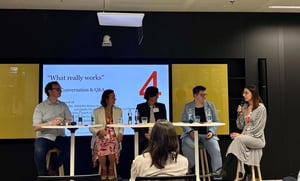
A look back at the Bridging Generations at Work evening organized by PwC Luxembourg: what we really learned about generations, commitment and value at work.
Last night, PwC Luxembourg organized Bridging Generations at Work, a conference devoted to intergenerational issues and the changing dynamics of collaboration within organizations.
In a particularly polished format combining keynotes, feedback and cross-fertilization, the evening brought together a number of speakers to address a question that has become central to many companies: how can we create work environments capable of enabling different generations, experiences, expectations and professional frames of reference to coexist?
The conference opened with a keynote by Anaïs Abchar, followed by a round-table discussion featuring :
- Alexa Fauth (Digital Learning Officer, FOYER GROUP)
- Ann De Jonghe (Human Resources Director, SODEXO)
- Clovis Fenart (HR Generalist, KETER)
- Mary Carey (Media Relations & Editorial Lead, PwC Luxembourg)
Beyond generations: what if the subject were elsewhere?
One of the main themes of the evening was to move beyond a strictly generational reading of work transformations.
Several speakers reminded us that the notions of "junior" and "senior" can no longer be reduced to a simple question of age. This was illustrated by a question raised during the round table by Ann De Jonghe:
"Is a 45-year-old woman who is retraining as a nurse junior or senior?"
A seemingly simple question, but one that immediately shifts the debate: professional experience, career path, sectoral seniority, managerial maturity or adaptability no longer naturally overlap.
In a context where almost 40% of employees report high levels of stress at work, the question no longer seems to be so much one of generations as one of how organizations structure, recognize and make legible career paths.
Commitment, alignment and transforming the relationship to work
In her keynote address, Anaïs Abchar returned to the changing relationship with work and the gradual transformation of engagement models.
A few key findings structured the discussions:
- 67% of employees believe that their work should make a positive contribution to society
- 44% of young professionals refuse certain assignments for ethical reasons
- a gradual shift from loyalty to alignment.
In other words, loyalty is not disappearing, but it is becoming conditional on coherence between discourse, practices and lived experience.
In this reading, generations appear less as homogeneous blocks than as different prisms for expressing common expectations: meaning, recognition, impact and quality of professional experience.
Generational diversity and collective intelligence
The speakers shared several concrete initiatives implemented in their organizations to strengthen intergenerational collaboration.
Alexa Fauth (Digital Learning Officer, FOYER GROUP) insisted on the need to go beyond generational stereotypes to focus more on complementarities and mutual learning dynamics.
Clovis Fenart (HR Generalist, KETER) presented an immersive initiative developed at KETER, in the form of a gamified workshop, aimed at making generation-related biases visible and working collectively on representations.
Discussions also highlighted a central point: intergenerational collaboration does not rely solely on devices, but on a managerial culture capable of creating dialogue, trust and spaces for transmission on a daily basis.
Luxembourg: a particularly revealing field
In a country like Luxembourg, where over 170 nationalities coexist within organizations, and where the workforce is both international and multi-generational, these issues take on a particular dimension. The labor market here combines high attractiveness and complexity of career paths, with a permanent tension between recruitment, commitment and retention.
In this context, the ability of organizations to create a common language between experiences and generations becomes a structuring lever for corporate culture. The evening concluded with a moment of networking, naturally extending these exchanges in a more informal setting.
Many thanks to the teams at PwC Luxembourg for organizing this conference and for the quality of the discussions on the changing world of work.